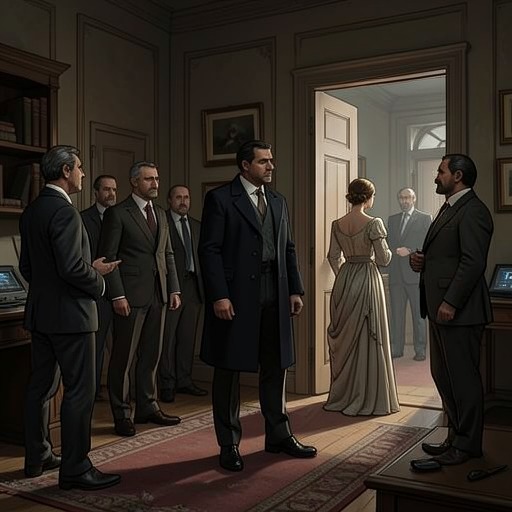
Giorgio Rabbia is abducted, tortured, and killed
Man on FireGiorgio Rabbia is abducted, tortured, and killed after Creasy uses the interrogation to gather information about the men and criminal connections around him. The episode turns a captive’s limited knowledge into a route toward more powerful figures, then ends with Rabbia’s body discovered beside a motorway and the violence entering the police record.
Capture and Interrogation
The account focuses on the final stage of Rabbia’s captivity: Creasy has him across a table and is drawing out details about his associates. The questioning is systematic rather than impulsive. Creasy moves through Rabbia’s friends, movements, and habits, then shifts the inquiry from Sandri to Fossella, applying the same sequence of questions to each. The method makes the interrogation an information-gathering operation as well as an act of coercion.
Rabbia complains that his hand hurts. The passage does not specify how the injury was inflicted, but the complaint makes the physical cost of the questioning explicit. Creasy does not pause the inquiry; he asks about Conti and Cantarella. The exchange shows Rabbia being kept alive while his knowledge remains useful, with pain and questioning proceeding together.
What Rabbia Reveals
Rabbia can provide little about the senior figures. He says that Don Cantarella hardly ever leaves Villa Colacci and that Rabbia himself has never seen him. His knowledge is therefore sharply bounded: he can identify Cantarella’s habitual seclusion, but cannot offer the kind of direct account that might come from personal contact.
Fossella, by contrast, has access to the higher level of the network. Rabbia says that Fossella goes to Villa Colacci often and visits Conti in Rome at least once a month. These details give Creasy a practical lead beyond the captive in front of him. They also distinguish Rabbia’s limited position from Fossella’s recurring proximity to the men who matter: Rabbia can report routes of contact without belonging to the innermost circle himself.
Once the questions are over, Creasy closes the notebook and caps his pen. Rabbia’s information has been recorded, and the objects that marked the interview’s orderly procedure are put away. The shift is decisive: the interrogation has reached its purpose, and Rabbia’s remaining words no longer serve Creasy’s immediate objective.
Killing Rabbia
Rabbia panics and begins talking again, babbling about Sandri and Fossella. Creasy is no longer interested. He stands, reaches beneath his jacket, and takes out a gun. Rabbia watches as Creasy screws a silencer onto its muzzle and walks around the table. The sequence is rendered through Rabbia’s attention to the weapon: he follows it as it is raised, sees it come closer, and feels the metal against his face just below his right eye.
Creasy’s last words to him are, “You are going to hell, Rabbia-you will not be lonely.” The sentence gives the killing a personal, retaliatory edge, but the scene does not extend into a speech or a further confrontation. The threat is delivered at the point of execution; Rabbia’s renewed attempt to bargain with information cannot alter what follows. The episode thus separates the practical value of what he knows from his fate once that value has been exhausted.
Discovery and Aftermath
Rabbia’s body is later found face up in a drainage ditch beside an access road to the Milan–Turin motorway. An ambulance and several police cars are gathered by the roadside. A large black-plastic bag lies folded on a stretcher, and a police photographer moves around the scene, recording the body. The discovery converts a private killing into a visible crime scene, surrounded by the procedures of emergency response and police documentation.
Mario Satta stands beside his assistant, Massimo Bellu, looking down at Rabbia. The transition to the roadside follows Satta’s lunch at Granelli’s, where he has complained to the headwaiter that the cappon magro contains too much rosemary. That mundane attention to a meal’s precise balance sits immediately before the view of the corpse, setting the measured routines of Satta’s day against the abrupt violence of Rabbia’s death. The scene does not report an arrest or resolve the investigation; it places Satta and Bellu at the body and leaves the killing’s consequences open to the continuing pursuit.